Movement: motors, reducers and grippers
Inside a robot joint: motors, reducers and encoders
A robot joint turns electrical power into controlled motion. Learn what the motor driver, motor, reducer, encoders and brake each do, and why many robots now use integrated actuator modules.
Each moving joint of a robot arm, leg or neck is a small machine of its own. Understanding it explains most of what you read in robot specifications: payload, speed, precision and how safe the robot is around people.
The motor driver
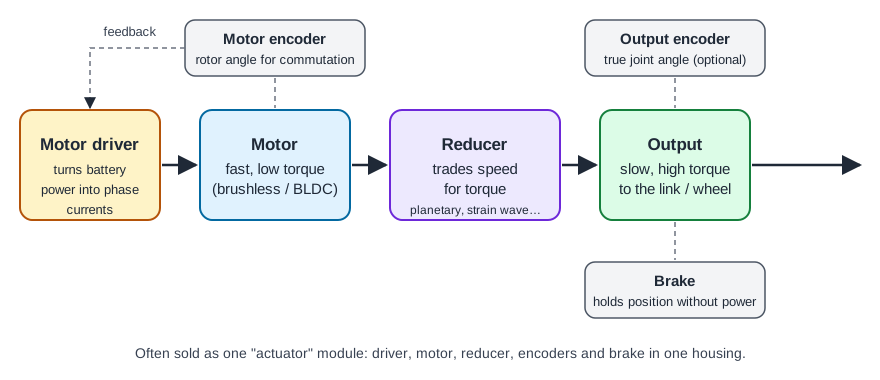
The driver (or servo drive) takes power from the battery or mains supply and feeds the motor the right currents at the right moment. For the brushless motors used in robots it has to switch the current between the motor phases as the rotor turns, which is why it needs to know the rotor angle.
The motor
Electric motors are good at spinning fast but produce relatively little torque for their size. Robots mostly use brushless DC (BLDC) or frameless torque motors, which are efficient and compact. See electric motors in robots.
The reducer
A reducer (gearbox) lowers the speed and multiplies the torque by roughly the same factor, so a small fast motor can move a heavy arm slowly and precisely. Robot arms and humanoids commonly use strain wave (harmonic), cycloidal or planetary reducers, each with its own trade-offs in precision, stiffness, size and cost. See robot reducers explained.
Encoders
Encoders measure rotation. A motor-side encoder gives the rotor angle the driver needs; an optional output-side encoder measures the real joint angle after the reducer, which helps accuracy and safety. Absolute encoders remember the position after a power cut; incremental ones need a homing move. See control and encoders.
Brake
Many arm joints include a brake that holds the joint when power is off, so the arm does not fall. Quadrupeds and humanoids often skip brakes to save weight and rely on the controller instead.
Integrated actuators
Many recent robots use actuator modules that package driver, motor, reducer, encoders and sometimes a torque sensor in one housing. This simplifies wiring and repairs: a failed joint can be replaced as one unit. Actuators designed for legged robots often use a low reduction ratio (quasi-direct drive) so the joint stays backdrivable: it can be pushed by the outside world, which helps absorb impacts.
Looking for spare joints? Browse actuators, reducers and motors in the parts catalog, each with its compatibility checked against robot models.