Movement: motors, reducers and grippers
Robot reducers explained: strain wave, cycloidal and planetary
Reducers let small motors move heavy robot links precisely. Compare the three main types used in robots, strain wave (harmonic), cycloidal and planetary gears, and what each is good at.
A reducer sits between the motor and the moving part of a joint. It turns many fast, weak motor revolutions into a slow, strong output rotation. Choosing the reducer shapes how precise, stiff, robust and expensive a robot is.
What matters in a reducer
- Ratio: how many motor turns make one output turn. Higher ratios give more torque but less speed.
- Backlash: the small play between the gear teeth. Less backlash means better repeatability.
- Stiffness: how little the joint twists under load.
- Backdrivability: whether the output can be turned by hand or by an impact.
- Size, weight and cost.
Strain wave (harmonic) reducers
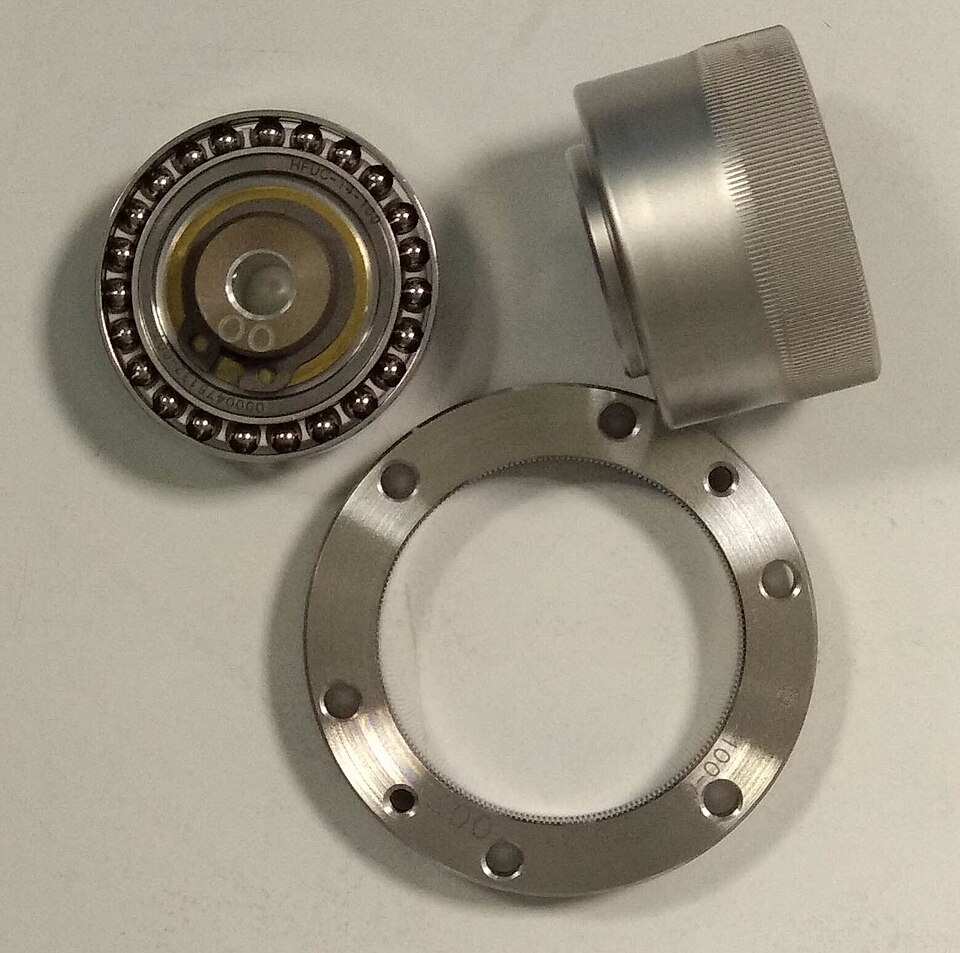
A strain wave reducer uses an elliptical wave generator to deform a thin, flexible toothed cup (the flexspline) inside a rigid ring gear (the circular spline). Because the flexspline has slightly fewer teeth, each turn of the wave generator advances it by just a few teeth, giving a high ratio in one compact stage with almost no backlash.
They are common in collaborative arms and humanoid arms because they are light, flat and precise. The trade-off is that the flexspline is a fatigue part and the joint is not very stiff compared with cycloidal designs.
Cycloidal reducers
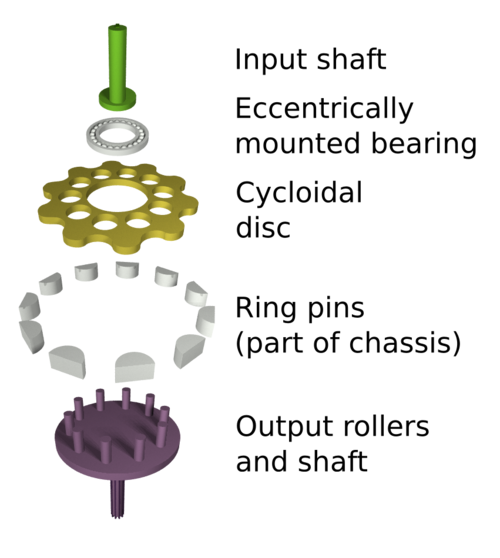
A cycloidal drive uses one or two lobed discs driven by an eccentric shaft. The discs roll inside a ring of pins and their slow wobble is taken off by output pins. They carry large loads and shocks well, are very stiff and have low backlash, which is why they are widely used in the base and shoulder joints of large industrial robots.
Planetary gears
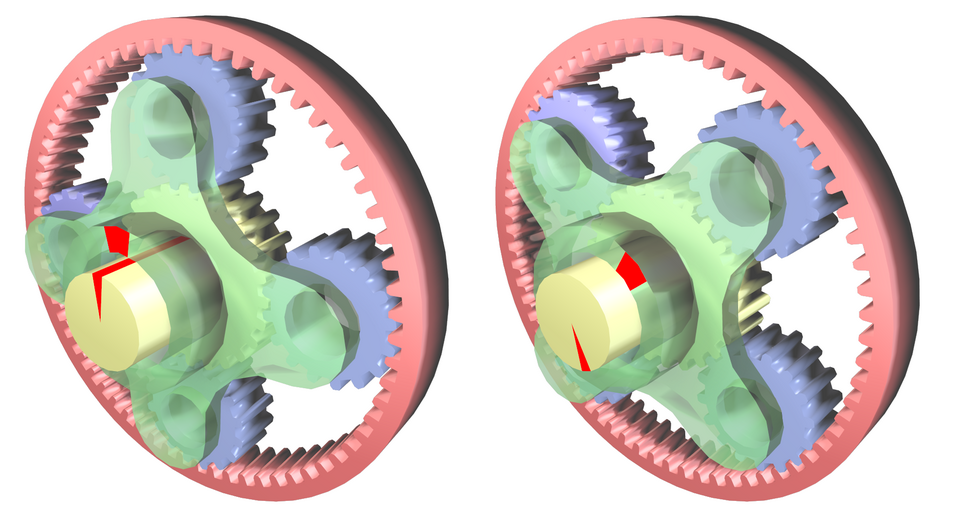
A planetary set has a central sun gear, several planet gears around it and an outer ring gear. It is simple, efficient, backdrivable at low ratios and inexpensive, which makes it popular in legged robots, mobile robots and hobby servos. Precision versions exist, but for the same ratio they usually have more backlash than strain wave or cycloidal reducers.
Which one does my robot use?
Manufacturers do not always publish it. As a rule of thumb, cobots and humanoid arms mostly use strain wave reducers, heavy industrial arms use cycloidal reducers in the main axes, and quadrupeds and wheeled robots often use planetary gears. Check the robot's documentation links in the catalog and the component makers in the company directory.
Buying a used arm? Reducer wear shows up as noise, vibration or lost repeatability. See how to buy a used robot.