The basics
How to read robot specifications: payload, reach, repeatability and more
Spec sheets are full of numbers that are easy to misread. What payload, reach, repeatability, degrees of freedom, IP rating and runtime really mean, and how to compare robots fairly.
Every robot page on DroidBazaar shows specifications with their source and date. This guide explains what the most common ones mean and the traps to avoid when comparing them.
Payload
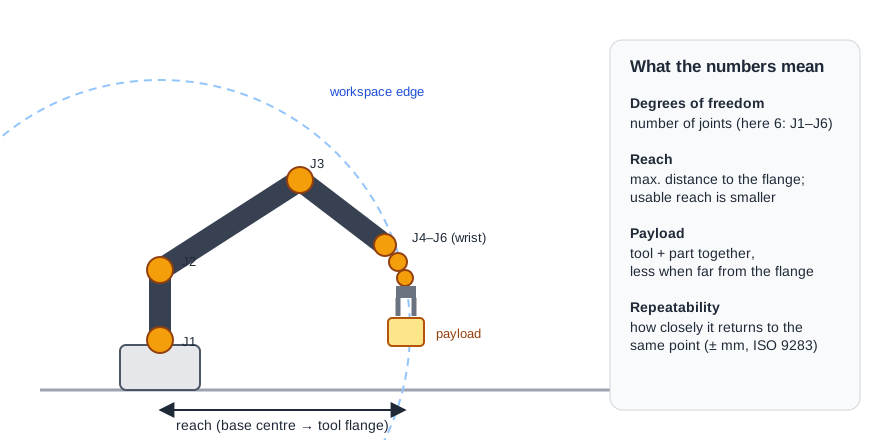
The maximum mass the robot can carry, including the tool. For an arm, a 5 kg payload with a 1 kg gripper leaves 4 kg for the part. Payload usually drops when the load's centre of gravity is far from the flange or when the arm moves fast; the full load diagram is in the manufacturer's manual. For mobile robots, payload is what the robot can carry on top, which is different from what it can tow.
Reach
For arms, the maximum distance from the centre of the base to the tool flange. Useful reach is smaller: near the edge of the workspace the arm cannot orient the tool freely.
Repeatability vs accuracy
Repeatability is how closely the robot returns to the same taught point, usually measured following ISO 9283 and quoted as ± a fraction of a millimetre. Accuracy is how close it gets to a point calculated in software, and is normally much worse unless the robot is calibrated. Most spec sheets only publish repeatability.
Degrees of freedom (DOF)
The number of independent joints. Six are enough for an arm to reach any position and orientation within its workspace; seven add flexibility. For humanoids, DOF counts are often quoted with or without hands, so check the notes.
Speed
Arms quote maximum joint speeds or a maximum tool speed; mobile robots quote a top speed. Collaborative robots may be limited to lower speeds when people are near. Top speed says little about cycle time; real cycles depend on acceleration and the path.
IP rating
The IP code says how well the robot is protected against dust (first digit) and water (second digit). IP54 resists dust and splashing water; IP67 survives temporary immersion. Check it for outdoor, food or washdown use.
Runtime and battery
Published runtimes are measured in specific conditions and often without load. We store battery capacity in watt-hours to compare robots with different voltages. See batteries and runtime.
Comparing fairly
- Compare the same variant: EDU, PRO and standard versions often differ.
- Check the notes under each value (for example "robot arm only" or "without battery").
- Prefer values from the manufacturer's datasheet or manual over marketing pages.
- A missing value on DroidBazaar means we found no reliable source, not that the value is zero.
Use the filters in the robot directory to narrow by payload, reach or runtime, then open each robot page to see every value's source.