Humanoids news
Short summaries of what matters in robotics, each linking to its original source, plus our own interviews and features. Have a story?
Stories
Mecka AI, founded in 2024, has raised a $60 million Series B led by Sequoia Capital, with Nvidia and Microsoft's M12 also investing, at a $500 million valuation. The company hires people to film themselves doing daily chores while wearing body sensors and using phones, turning that human motion into data for training humanoids and other robots.
· TechCrunch
Boston Dynamics has appointed Rohit Prasad, who led Alexa and the Nova foundation models at Amazon, as its CEO from October 7, taking over from interim chief and CFO Amanda McMaster. The Hyundai-controlled maker of Atlas, Spot and Stretch says the hire is meant to push its AI-driven robots toward large-scale commercial use.
· The Robot Report
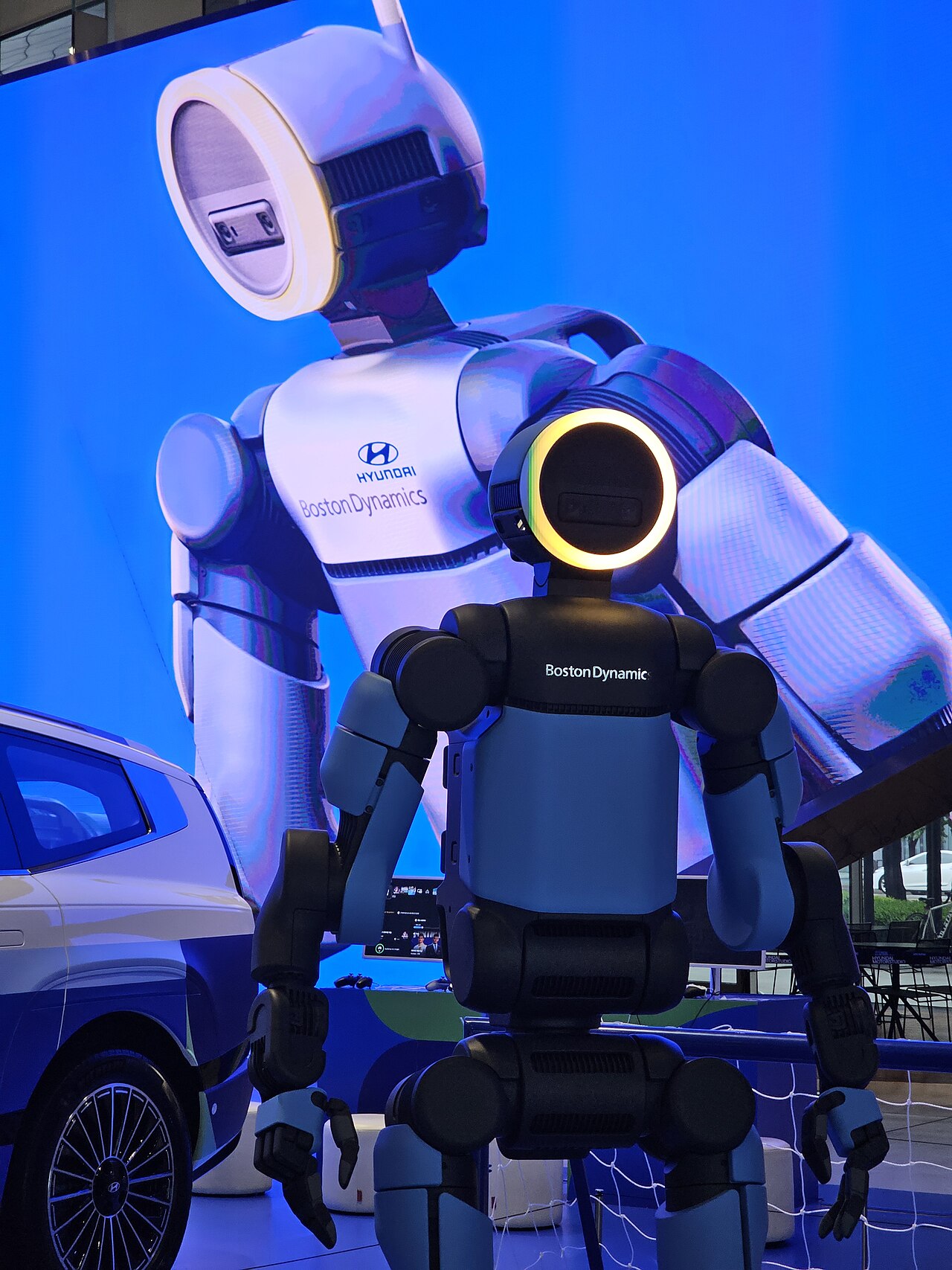
Boston Dynamics has detailed a new hand for its Atlas humanoid with four fingers, an opposable thumb and 13 degrees of freedom, up from 7 on the previous version. The team left out a little finger to save three actuators and their cost and failure risk; the hand has tactile sensors in the fingertips and palm and is meant for tool use and in-hand manipulation.
· Boston Dynamics · Photo: Damian B Oh, CC BY-SA 4.0
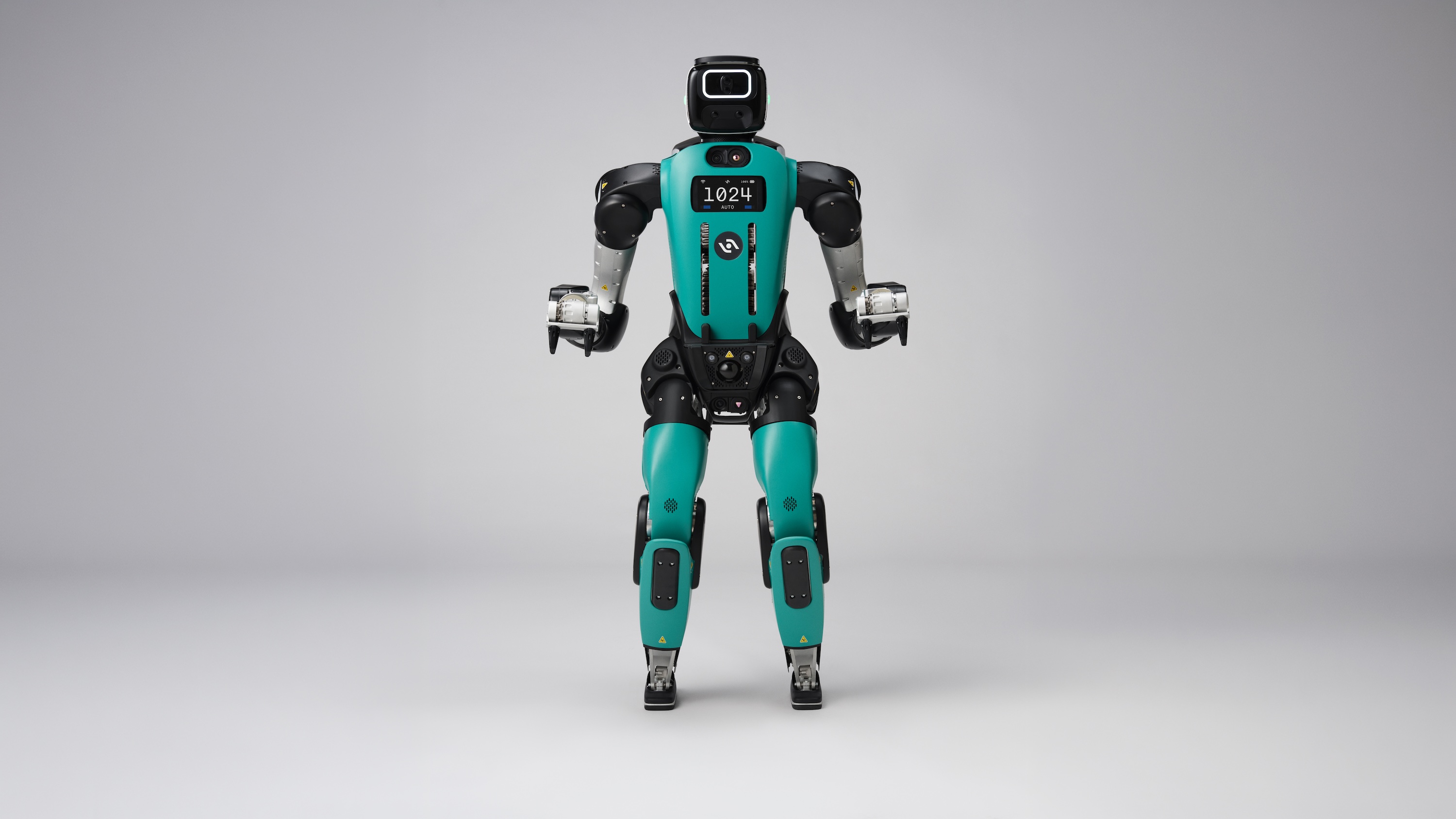
Agility Robotics and FORT Robotics have signed a memorandum of understanding to build safety infrastructure for Digit 5, including a pendant with emergency stop and enabling functions and a bridge to plant safety systems. The aim is to let the humanoid work near people at scale; earlier Digit versions have logged over 65,000 operating hours.
· Robotics Tomorrow · Photo: Agility Robotics, Press photo
Data services company Innodata has opened a motion-capture facility in Ridgefield Park, New Jersey, that records human and robot movement with sub-millimetre optical tracking. Humanoid developers can buy the data, commission custom captures, retarget motion between platforms or send robots for independent performance and safety testing.
· The Robot Report
San Francisco and Paris startup Flourish has introduced Flourish One, a Raspberry Pi-based wheeled humanoid for household chores such as tidying and wiping tables. Owners teach it new tasks by moving their smartphone while the robot mirrors them, with training done on cloud GPUs. A first batch of 50 units is expected to ship before Christmas 2026.
· The Robot Report
DYNA Robotics has released DYNA 2.1, a semi-humanoid with a two-armed torso on four steerable wheels, already working in hotels, laundromats and restaurants. The company says it can run a full commercial laundry shift, from washers and dryers to folding and shelving towels, using its DYNA 2 model trained on one million hours of human and robot data.
· Robotics Tomorrow
Edge AI chipmaker SiMa.ai closed a $150 million Series C co-led by Fidelity and Amplify, bringing total funding to $500 million. The company plans to use the money for its Palette Neat software and next-generation chips aimed at humanoid robots, drones and driver assistance, with new hardware rated at 1,000 dense TOPS due in the first half of 2028.
· Robotics Tomorrow
Agility Robotics CEO Jonathan Hurst confirmed the company is evaluating other form factors, including wheels, for sites where legs are not needed, without saying whether this means a wheeled Digit or a new platform. The move comes as Agility prepares a SPAC listing at a $2.5 billion valuation and reports a Digit 5 backlog above $300 million from one customer.
· The Robot Report
Feather, founded by former 1X engineer Hoa Mai and former Tesla engineer Parsa Bakhtiari, is building a customizable humanoid that software developers can adapt to jobs such as kitchen work or lab cleaning. The startup raised a $7.6 million pre-seed led by Gradient Ventures, says it has already passed $1 million in revenue, and is field testing ahead of a wider launch.
· TechCrunch
Tokyo startup O-ID, founded in 2025, raised $1.2 million led by TAWANI Ventures with Hustle Fund and Techstars to build humanoids whose joints, limbs and compute units can be exchanged on site. It aims to bring its first robot from prototype into production for Japanese factories, and has filed a provisional US patent for its modular connector.
· Robotics Tomorrow
At its first robotics supply chain partner conference on September 22, carmaker XPENG said the production line for its IRON humanoid is running, with mass production to begin before the end of 2026. The robots will first work in XPENG stores and campuses, with market launch and deliveries in China and abroad planned for 2027.
· Robotics Tomorrow
AGIBOT and Chimelong have opened a first phase with more than 300 robots at Chimelong Spaceship Park in Zhuhai, China, used for shows, guest guidance, retail, education and hotel services. The deployment included AGIBOT's 20,000th production robot, and the partners are setting up a joint institute on robots in tourism.
· Robotics Tomorrow
Boston Dynamics and Hyundai Motor Group have opened the Robotics Metaplant Application Center near Savannah, Georgia, where Atlas humanoids are trained on automotive work such as parts sequencing. The center is planned to grow roughly tenfold by 2027, as Hyundai prepares for 25,000 Atlas units across Hyundai and Kia plants.
· Robotics Tomorrow · Photo: Damian B Oh, CC BY-SA 4.0
Agility Robotics is presenting Digit 5 as a humanoid built to share space with workers: it pauses, avoids hazards or sits down when people come close and is designed so it cannot fall onto them. The 129 kg robot lifts 23 kg to 2.1 m, has not yet been deployed in factories, and is expected in the EU and UK in 2027.
· IEEE Spectrum · Photo: Agility Robotics, Press photo
In a Science Robotics study, 50 people talked with a Pepper robot that sometimes erred while being either animated or still. Mistakes cut trust in both cases, but brain imaging showed errors from the animated robot were processed more like social violations, and higher oxytocin predicted lower trust, a finding relevant to humanoid interface design.
· Robohub