Research news
Short summaries of what matters in robotics, each linking to its original source, plus our own interviews and features. Have a story?
Stories
Physical AI lab Nature Will has announced Natura-1, a foundation model with 50 billion parameters built to control dexterous robot hands from natural-language instructions it has not seen before. The company says the model was pre-trained on more than 1 million hours of egocentric human data and runs a 100-millisecond control loop on real hardware. No availability, pricing or supported hardware was disclosed.
· Robotics & Automation News
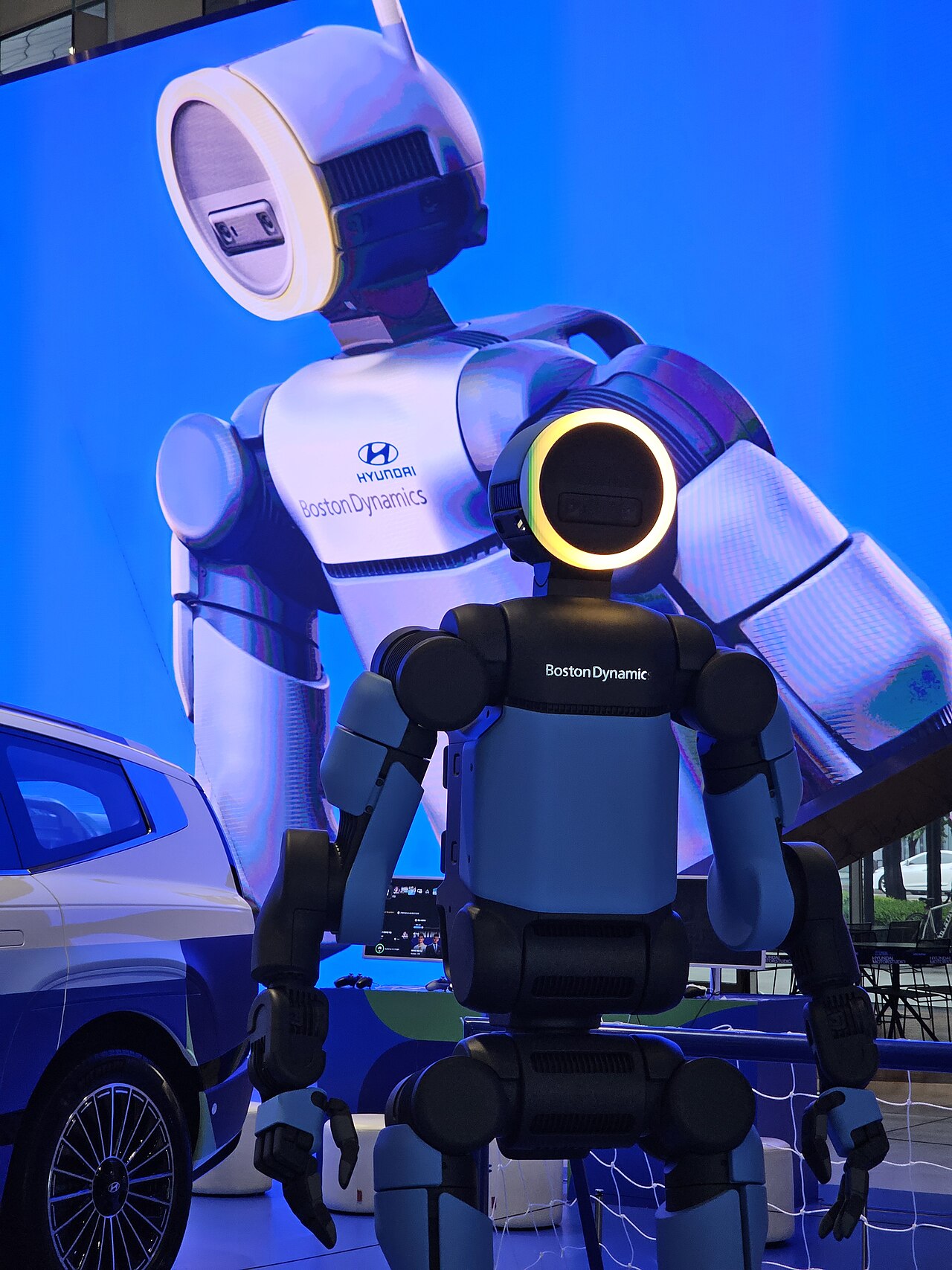
Boston Dynamics engineers swapped the feet of the Atlas humanoid for scooter wheels, using a single custom adapter on the existing ankle actuators, to push the motors to sustained high torque and speed. Policies trained in simulation with a carefully tuned motor model transferred closely to the real robot, which landed a 360-degree jump on the first attempt. The company says the wheeled Atlas is a research testbed, not a product, and that the lessons will feed back into the standard robot.
· Boston Dynamics · Photo: Damian B Oh, CC BY-SA 4.0
DARPA says a system built by Caltech has assembled a truss structure in orbit for the first time, as part of its NOM4D program on space manufacturing. A simple three-axis gantry robot inside an automated box joins modular elements at nodes, attaches a reflective mesh and deploys each finished section. The prototype flew on a SpaceX rocket 15 months after the decision to test in orbit, and the program targets structures hundreds of metres to kilometres in size, such as solar power satellites.
· heise online
Andreea Bobu's CLEAR Lab at MIT built FLEX, a pipeline that edits a robot's motion-planning features from conversational commands and uses GPT-4o to generalize them into wider rules, such as avoiding all fragile objects after being told to avoid a mug. In simulated arm tasks it took about five seconds and could make home and assistive robots easier to direct.
· MIT News
A team at the Shenzhen Institute of Advanced Technology has built a flexible hip exosuit that assists both flexion and extension underwater to counter water resistance. In trials reported in Science Robotics, breathing gas consumption per minute fell 29.77% for flutter kicks, 25.7% for frog kicks and 18.35% when walking on the bottom.
· heise online
Researchers at the University of Tartu and the Italian Institute of Technology built a 3D-printed moth robot whose internal veins carry about 3 ml of fluid containing pyrrole. Under UV light and a stencil, the fluid turns into conductive polypyrrole in a wing patch, creating a UV sensor that triggers an LED or wing flaps. The work, in Advanced Science, points to robots adding sensors in the field.
· New Atlas
MIT researchers led by Luca Carlone developed UQ-DAAAM, which scores how reliable a vision-language model's description of an object is by checking its confidence and consistency across viewpoints, then picks extra views when needed. It resolved ambiguity for about 92% of objects with two more captions each and improved description accuracy by 5%. The work will be presented at NeurIPS.
· MIT News
University of Toronto researchers designed a wider, spiked foot pad with rubber-band return springs for the Hopcopter, a one-legged hopping quadcopter from City University of Hong Kong and HKUST. Tests on ice, sand and rocks showed 84% less performance variation across terrains. The team is commercializing the design as Hop-1, aimed at search and rescue and remote inspection.
· New Atlas
Researchers at UCLA and UC Davis have built an insect-sized flying robot made entirely of polymer, with flexible wings driven by an electrically actuated soft muscle. The 185 mg prototype lifts three times its weight and kept flying after being swatted and loaded with 11,000 times its own mass, according to a Science Robotics paper. It still relies on external power; the team sees uses in inspection and search and rescue in tight spaces.
· heise online
According to The Information, Meta has developed a household humanoid named Max together with Chinese robot maker Fourier, a roughly 1.5 m, 48 kg machine running on Nvidia Jetson AGX Thor, with a second version already in development. Meta told heise the robots are an internal research project and that it has no plans to sell them.
· heise online
Lab automation company Opentrons Labworks has closed a $40 million Series E led by Avego, with BroadOak Capital Partners also investing. It says more than 11,000 of its robots work in labs across over 80 countries, and it will use the money to expand its Flex platform, software and data tools, and AI-run experiments into new markets.
· Robotics & Automation News
MIT engineers led by Giovanni Traverso built a soft robotic enteroscope that alternately inflates balloons and uses kirigami-patterned grip surfaces to crawl through the small intestine. In animal tests it travelled about six and a half feet and used its camera, drug sprayer and clips. The work appears in Science Robotics.
· MIT News
Researchers at Leiden University tested Ryberg Healthcare's autonomous Omnia UV-C robot in a lab furnished like a hospital and found it exceeded the 5 log reduction target for several bacteria. Moving on its own, it beat a static lamp with the same dose, especially in shadowed spots. Results appear in Infection Prevention in Practice.
· Robotics & Automation News
A National University of Singapore team has made the eLuminator, a 70-micrometre flexible film that emits light at the point of contact and glows brighter under more pressure, while also measuring force electronically. Described in Nature Communications, it could give robot hands and prosthetics finer touch, though it still needs an external 150 V supply.
· New Atlas
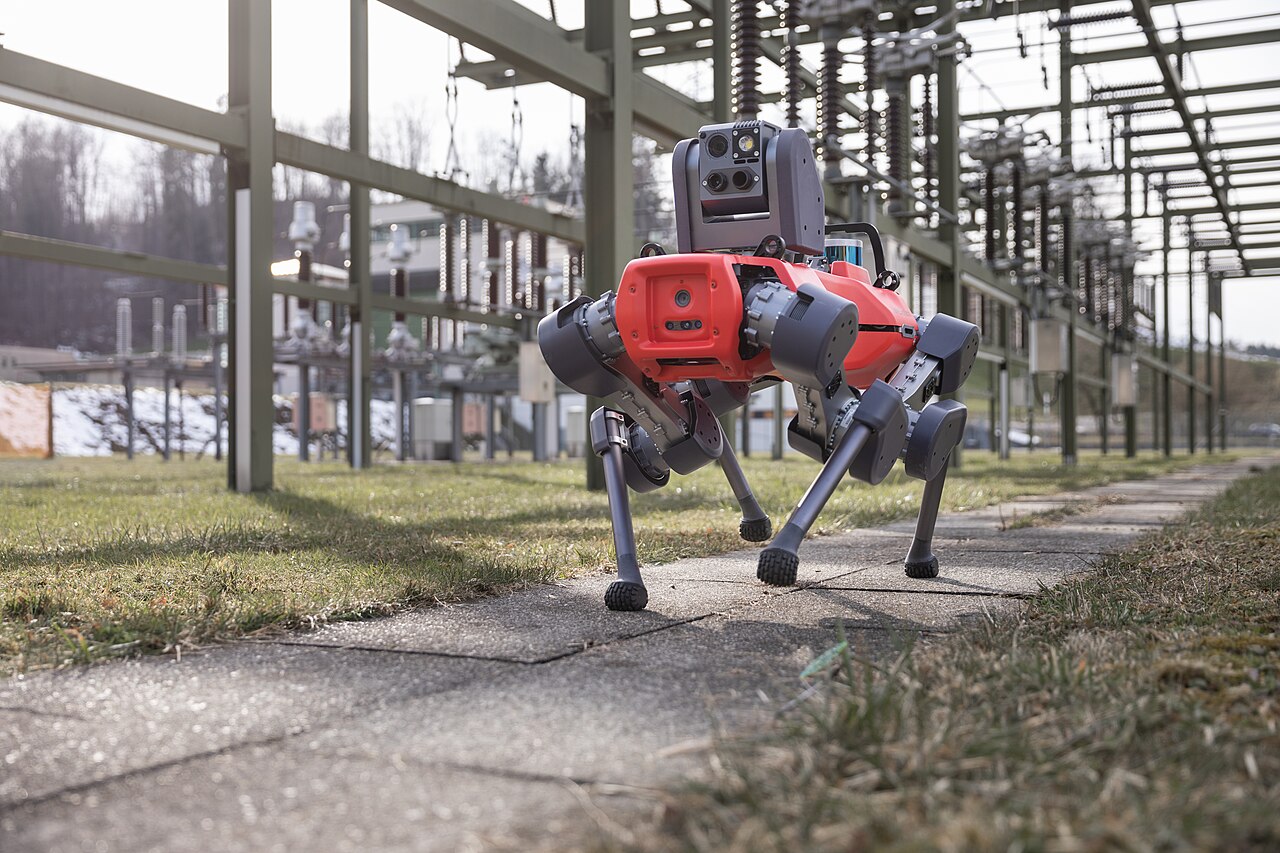
Researchers at ETH Zurich's Robotic Systems Lab got an ANYmal-D to solve an oversized 4.6 kg Rubik's Cube using its front legs while balancing on its hind legs. The robot scans the cube with its camera, plans about 30 moves with a solver and uses a reinforcement-learned balance policy; each of three runs took eight to nine minutes, showing legged robots can manipulate objects without arms.
· heise online · Photo: Cvoellmy, CC BY-SA 4.0
KAIST researchers built BeetleBot, a robot modelled on an African beetle that walks and grips with 3D-printed liquid crystal elastomer muscles that contract about 45% when heated. An operator steers it with a bend sensor worn on a finger while a camera streams its view back. In lab tests it turned, grabbed an object and carried it elsewhere, pointing to inspection of tight spaces.
· New Atlas
Researchers at North Carolina State University have built a soft underwater robot modeled on the feather star, using elastic limbs driven by only two actuators. It can rise, hover, swim forward or backward and spin in place, where a conventional design would need at least six actuators. The team sees uses in underwater exploration, carrying cameras and lifting objects.
· New Atlas
ETH Zurich's Soft Robotics Lab has made 1.5 cm actuators that pair mouse-derived skeletal muscle tissue with light-printed hydrogel scaffolds, designed in simulation for maximum movement. Reported in Nature Communications, they jump, swim, grasp and walk at 6.2 mm/s, but still need a nutrient bath to stay alive.
· Robotics & Automation News
Google DeepMind showed its new Gemini 4 Argon model watching a video of a person playing cornhole, building a simulation of the task and passing the learned motion to Apptronik's Apollo humanoid, which then landed seven throws in a row. Google says the video-to-simulation pipeline can shrink weeks of manual setup to a few hours.
· Robotics & Automation News
Former OpenAI science lead Kevin Weil has launched Warp Sciences, which raised $215 million at an $865 million valuation in a round led by Lightspeed. Chemists wearing cameras and sensor gloves will teach robots to synthesize and test compounds around the clock, work that biotech firms often outsource abroad.
· TechCrunch